July 21, 2026
·OpenEphemeris Team
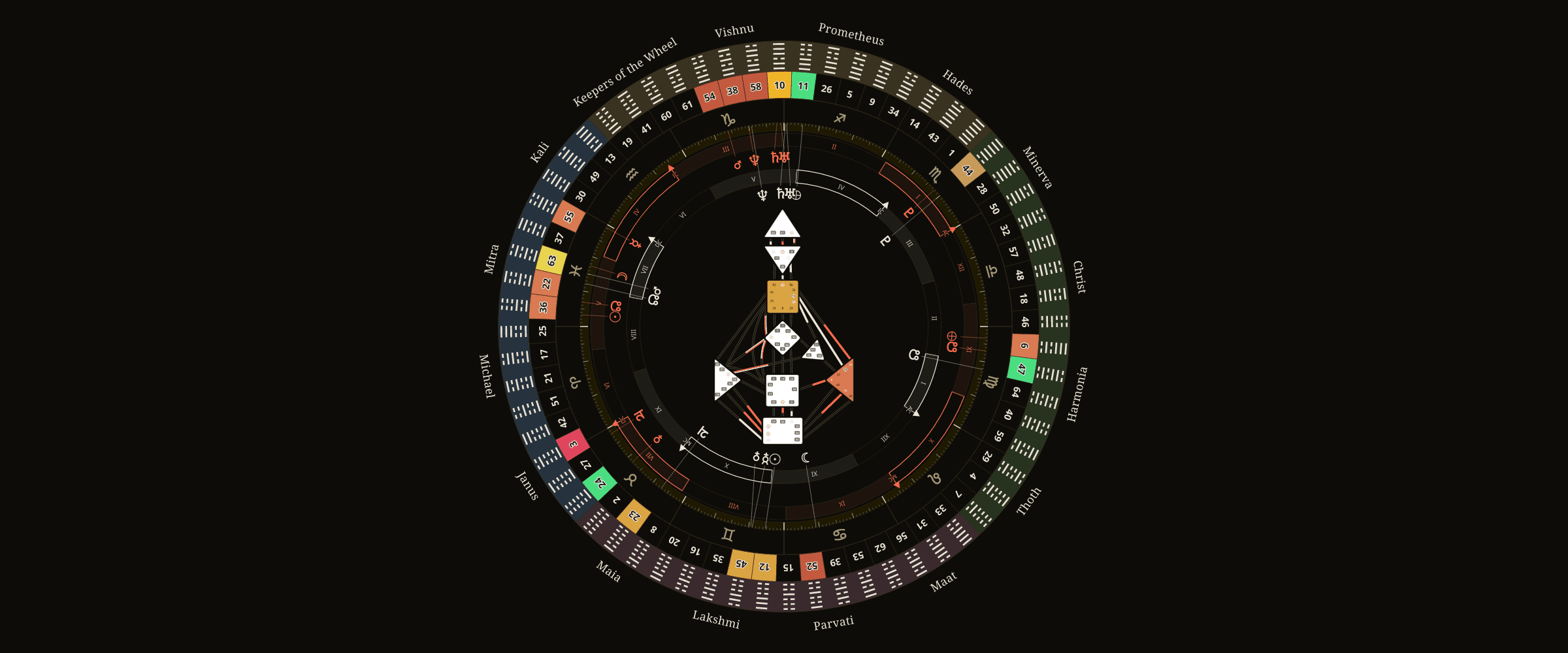
The Human Design Bodygraph, Drawn as a Full Mandala
Render the Human Design bodygraph as a full mandala — I Ching wheel, zodiac, and twin astrological house rings computed from real cusps. One API call.
The Human Design bodygraph is usually drawn as a body: nine centers, stacked head to root, wired together by channels. That picture is the useful one. But it is only the middle of a larger diagram.
Human Design was assembled from four older systems — the I Ching, the Western zodiac, the Hindu chakras, and the Kabbalist Tree of Life. In the original synthesis the bodygraph sits at the center of a wheel, ringed by the 64 hexagrams and the twelve signs, with the planets placed on the sky exactly where they were at birth. We have added that wheel to the bodygraph endpoint, and then we added something the original never had: the houses.
You get it with one query parameter. layout=mandala wraps the same bodygraph — the one computed from NASA JPL's DE440 ephemeris, the same centers and channels — in its concentric rings.
The rings, from the outside in
The outermost band names the sixteen Godheads, the archetypal quarters of the wheel. Inside it, every one of the 64 gates carries its I Ching hexagram, drawn line by line — solid for yang, broken for yin — so the trigram structure is visible, not just the gate number. Then the zodiac: the twelve signs, tinted by element, with a degree scale fine enough to read a planet's position to the degree.
The gates themselves are colored by center, the way a practitioner expects — Head and G in yellow, Ajna green, the Heart and Sacral red, the rest in warm browns. An activated gate is filled; an open one is hollow. Which means you can read someone's definition on the rim of the wheel before your eye ever reaches the body in the middle.
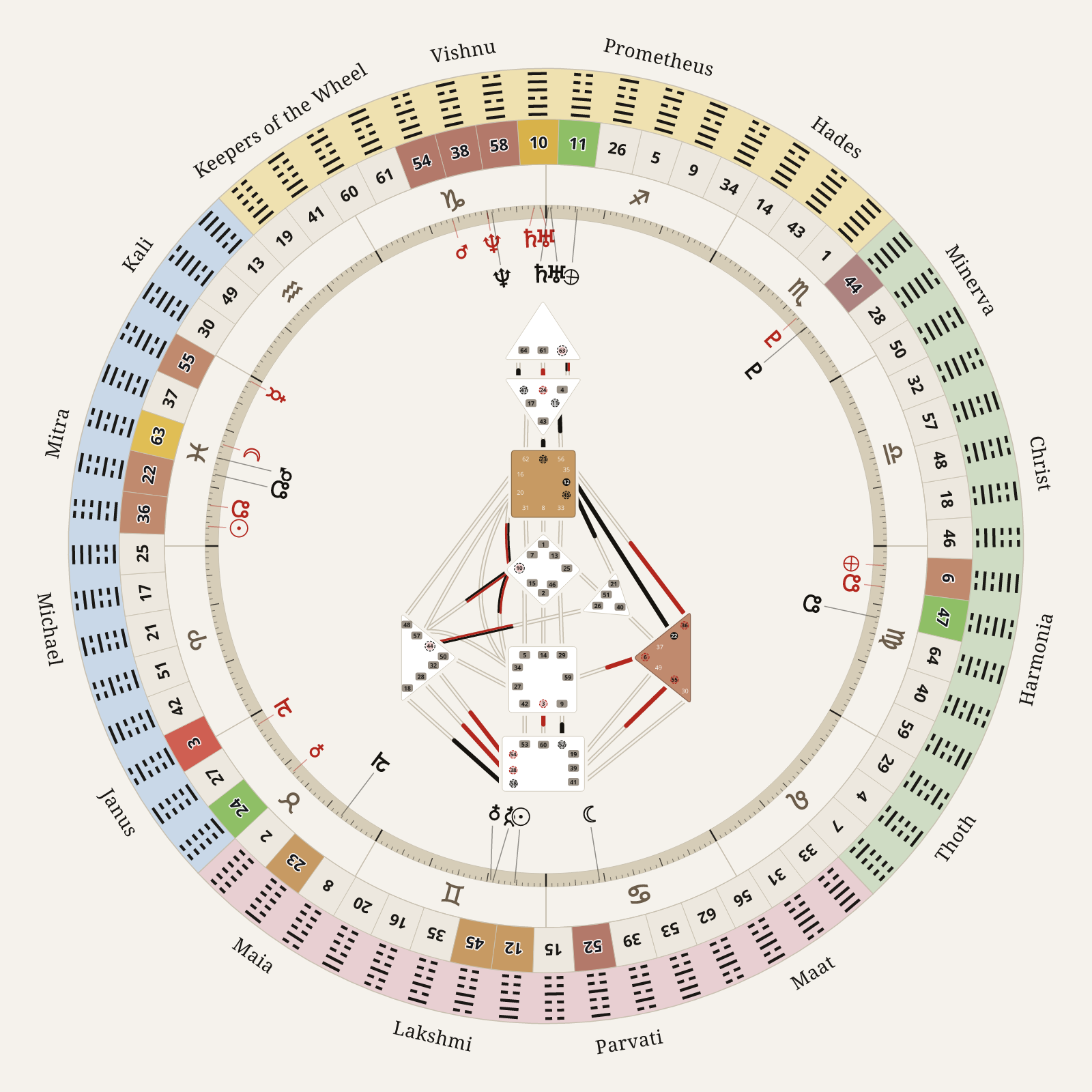
Every ring is optional. Ask for rings=zodiac,planets and you get a spare wheel; ask for the full set and you get the whole synthesis. Whatever you leave off, the bodygraph in the center grows to fill the space it reclaimed — it is always drawn as large as the enabled rings comfortably allow.
The planets sit where the sky put them
Around the open disc between the rings and the body, the planets are placed at their true ecliptic longitude — Design in red, Personality in ink, the two sides Human Design is built from. Each glyph sits on its exact degree, with a fine leader line back to the scale. When two planets are close enough to collide, they step apart around their shared midpoint rather than overlapping — but neither one is nudged off its real position. The glyph is legible; the leader is honest.
This mattered enough that we changed the engine for it. A bodygraph is normally computed from a single instant and needs nothing else — so the underlying position, the planet's longitude on the ecliptic, was thrown away the moment it was converted into a gate and line. To place a planet on the zodiac ring precisely, we had to carry that longitude all the way through. Now we do.
Two house rings, because there are two charts
Here is the part no other Human Design tool draws.
Every Human Design chart is really two moments. The Personality is calculated at the moment of birth. The Design is calculated about eighty-eight days earlier — not eighty-eight days of calendar, but the time it takes the Sun to travel exactly 88° of arc backward from the birth position. Two moments means two skies, and two skies mean two Ascendants. The horizon was in a different place both times.
So a single house ring cannot describe a Human Design chart. It needs two. Turn on rings=houses with a birth location, and the mandala draws both: a Personality house ring at the birth moment and a Design house ring at the design moment, each with its own cusps and its own four angles — Ascendant, Descendant, Midheaven, Imum Coeli — marked and labelled where they actually fall. Because the two Ascendants differ, the two rings genuinely disagree, and that disagreement is the point.
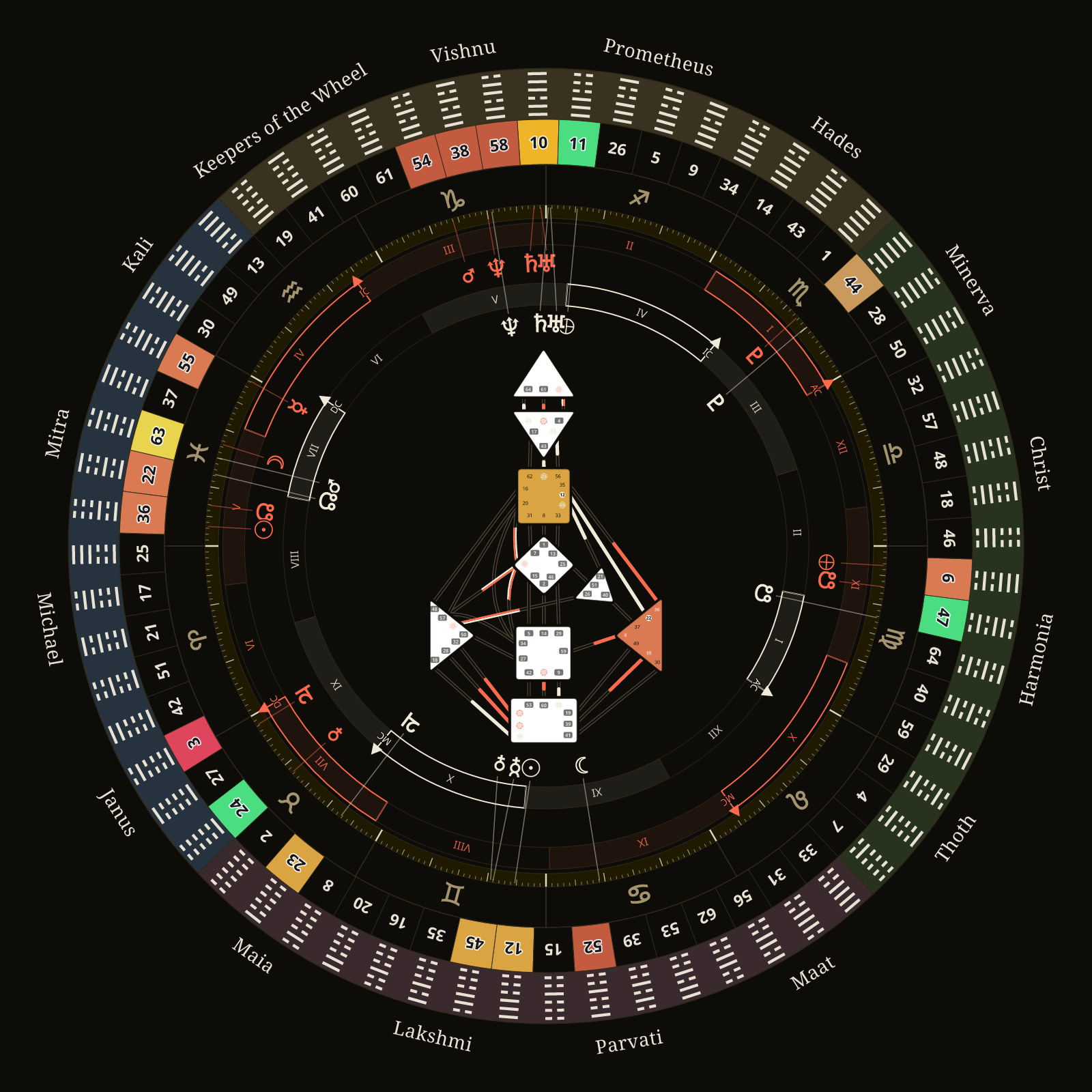
The houses are drawn from real cusps, not equal thirty-degree slices. Ask for Placidus and you get Placidus — unequal houses, the Midheaven landing exactly on the tenth cusp. Seven systems are available, Placidus through Whole Sign, on a house_system parameter.
Because the houses need a birth latitude and longitude — a place, not just an instant — they are the one thing that costs a little more. The house ring adds a single credit, and only when it actually renders. Leave the location off and the ring is simply, quietly absent; you are never charged for something you did not get.
What happens at the top of the world
House systems have a famous problem near the poles. The popular quadrant systems — Placidus, Koch, Regiomontanus, Campanus — are built on the ecliptic crossing the horizon a certain way, and inside the polar circle it stops crossing that way at all. The math has no answer. Every serious astrology program falls back to a simpler system, Porphyry, when it can no longer compute the one you asked for.
The question is where that boundary sits, and whether the program tells you it moved.
We fixed both. The fallback now triggers at the true polar circle — 90° minus the tilt of the Earth's axis, about 66.56° — rather than a rounded-off 66°, which means charts in that thin band between the two, where Placidus is still perfectly well-defined, now get the Placidus you asked for. And when the fallback does trigger, the response says so: it reports that a substitution happened, names Porphyry as what you actually got, and explains why. This is exactly how the Swiss Ephemeris — the calculation library behind most astrology software — behaves. A chart in Longyearbyen should never quietly claim to be Placidus when it is not.
Or, just ask Claude
If you have OpenEphemeris connected to Claude — as a connector or through the @openephemeris/mcp-server package — you do not need the query parameters at all. Ask for a Human Design bodygraph, and the interactive chart that renders in the conversation carries a Mandala view button in its action bar. Click it, and the same rings appear on the same chart, computed by the same call to the endpoint above — Claude just wrote the request for you.
House rings get their own control there too: a location-gated "Add house rings" checkbox, labelled with its cost up front, off by default even with the mandala on. A view toggle should never silently bill you for a click — so it does not.
Try it
The mandala layout and both house rings are live on POST /visualization/bodygraph right now. The simplest possible call is a birth moment and a layout:
curl -X POST "https://api.openephemeris.com/visualization/bodygraph?layout=mandala&format=svg" \
  -H "Authorization: Bearer $OE_API_KEY" \
  -H "Content-Type: application/json" \
  -d '{"birth_datetime_utc":"1988-06-15T14:30:00Z"}'
Add a location and the house rings to get the full picture:
curl -X POST "https://api.openephemeris.com/visualization/bodygraph?layout=mandala&rings=godhead,quarter,hexagrams,zodiac,planets,houses&house_system=placidus&format=png&size=1600" \
  -H "Authorization: Bearer $OE_API_KEY" \
  -H "Content-Type: application/json" \
  -d '{"birth_datetime_utc":"1988-06-15T14:30:00Z","latitude":40.71,"longitude":-74.01}'
Either one returns the whole diagram — the bodygraph you know, drawn where it was always meant to sit: at the center of the wheel.