OPEN EPHEMERIS

Open Ephemeris Sky · coming to ChatGPT and Claude

Ask your assistant about the real sky.

Golden hour, blue hour, moonrise, the Milky Way, planets and eclipses, for any place and date. Every answer is computed from NASA JPL's DE440 ephemeris, never guessed.

Live · computed from NASA JPL DE440

Today's sky near Columbus

2026-11-19 · times in America/New York

Light

Sunrise
7:21 AM
Sunset
5:12 PM
Morning blue hour
6:52 AM to 7:03 AM
Morning golden hour
7:03 AM to 8:02 AM
Evening golden hour
4:32 PM to 5:30 PM
Evening blue hour
5:30 PM to 5:41 PM

Night

Truly dark (no Sun, no Moon)
2:43 AM to 5:48 AM
Moon
76% lit
Moonrise
2:12 PM
Moonset
1:37 AM

Planets you can see tonight

  • Venus4:33 AM to 7:22 AM
  • Jupiter11:43 PM to 7:22 AM
  • Mercury5:43 AM to 7:22 AM
  • Saturn5:12 PM to 3:12 AM
  • Mars11:48 PM to 7:22 AM

Mars and Jupiter pass 1.9° apart at 11:42 PM.

Times are for your area, rounded to about 25 km. Use your location for your exact spot.

What Sky does for you

Be out when the light is right.

Golden hour, blue hour and the truly dark hours, to the minute, for any spot and date. Arrive before the light, and pick the night the Moon is down for the Milky Way.

Ask“When is golden hour on Saturday at Arches National Park?”
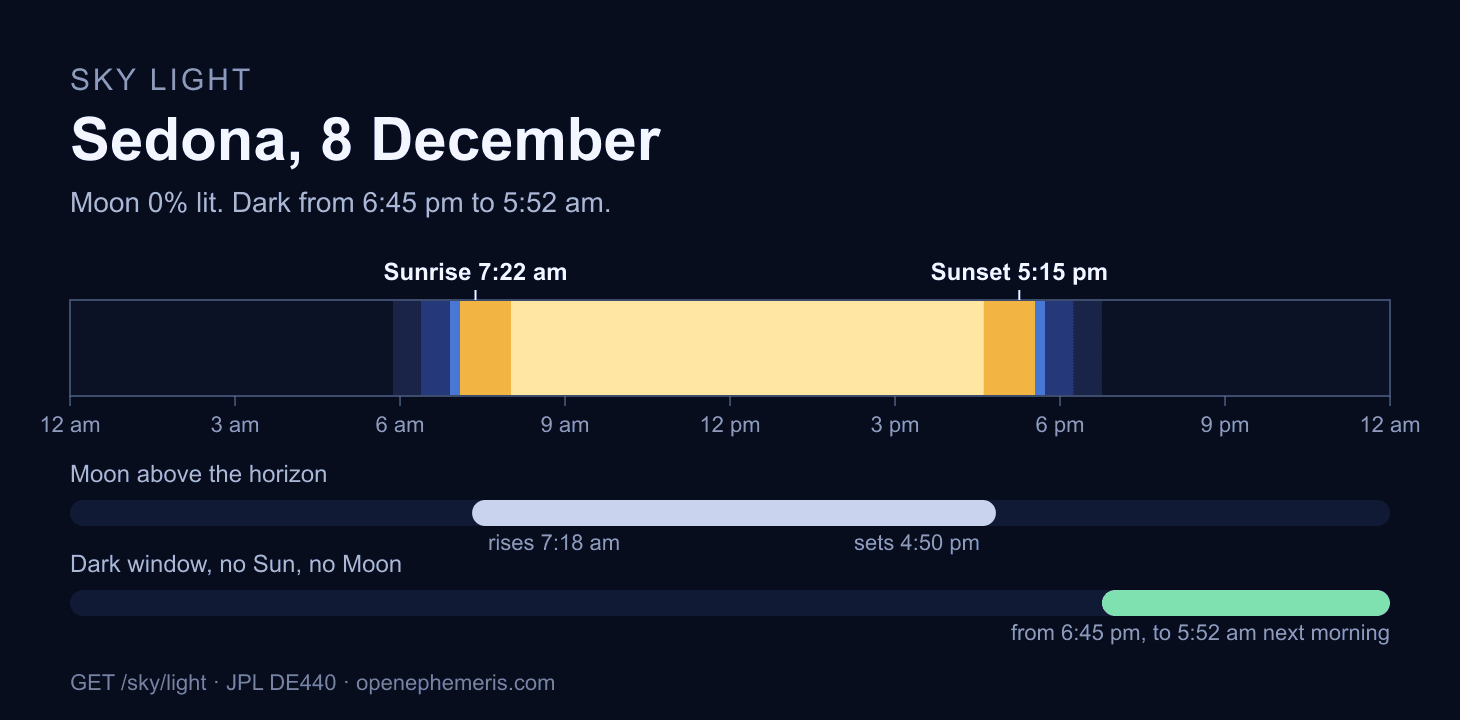
One day's light drawn for Sedona: golden and blue hour, when the Moon is up, and the dark window.
Drawn from the Sky light data for Sedona.

Know what you are looking at, and when.

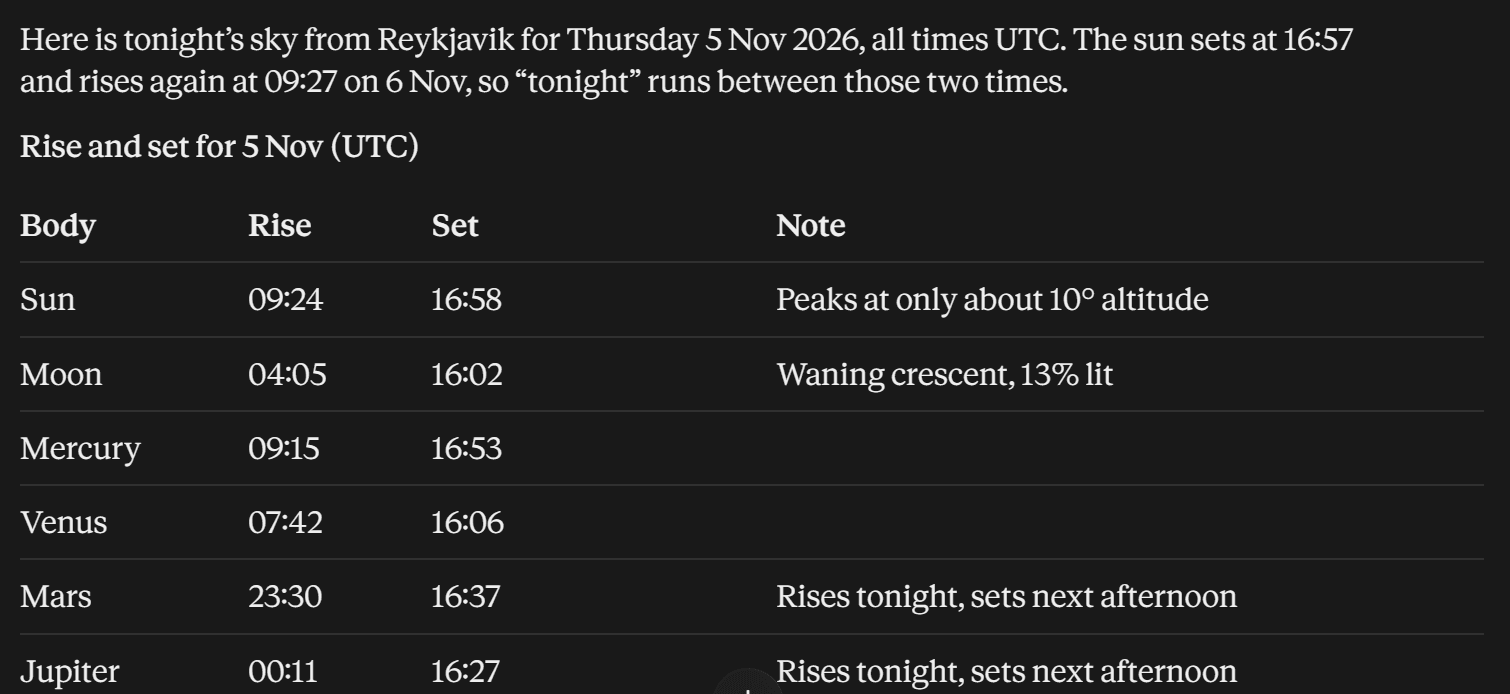
Every planet's rise, set and brightness from where you stand, so you know which bright point is Jupiter and how late you need to stay up.

Ask“What planets can I see tonight, and where do I look?”

An assistant's table of tonight's rise and set times for the Sun, Moon and planets from Reykjavik.
A real answer from Open Ephemeris.

Catch the first thin crescent.

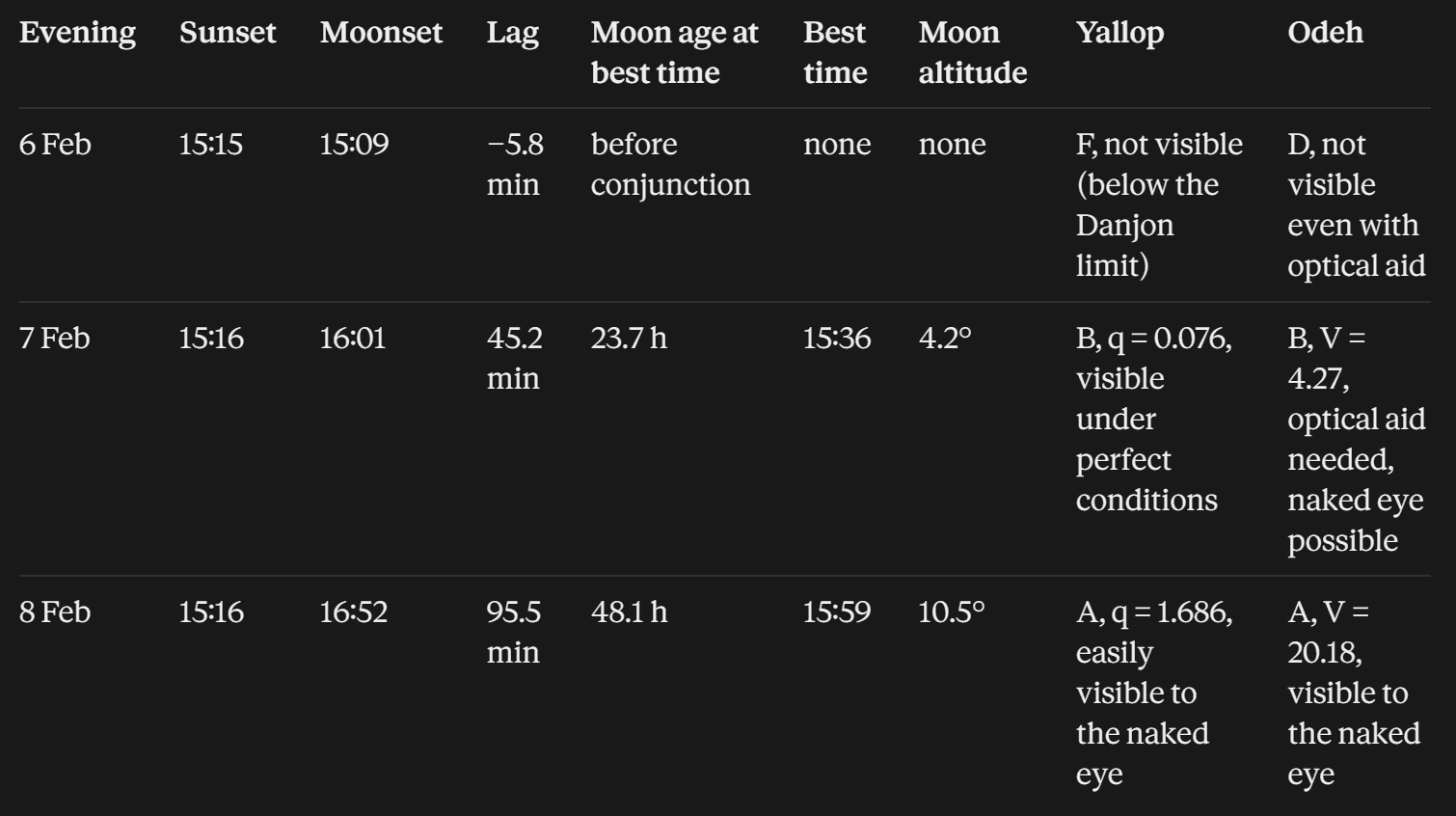
The evenings after New Moon rated by the Yallop and Odeh tests, so you know which evening the crescent can be seen and when to look.

Ask“When is the first crescent Moon visible this month?”

A table of three evenings with sunset, moonset, Moon age and the Yallop and Odeh visibility grades.
A real answer from Open Ephemeris.

Never miss the big nights.

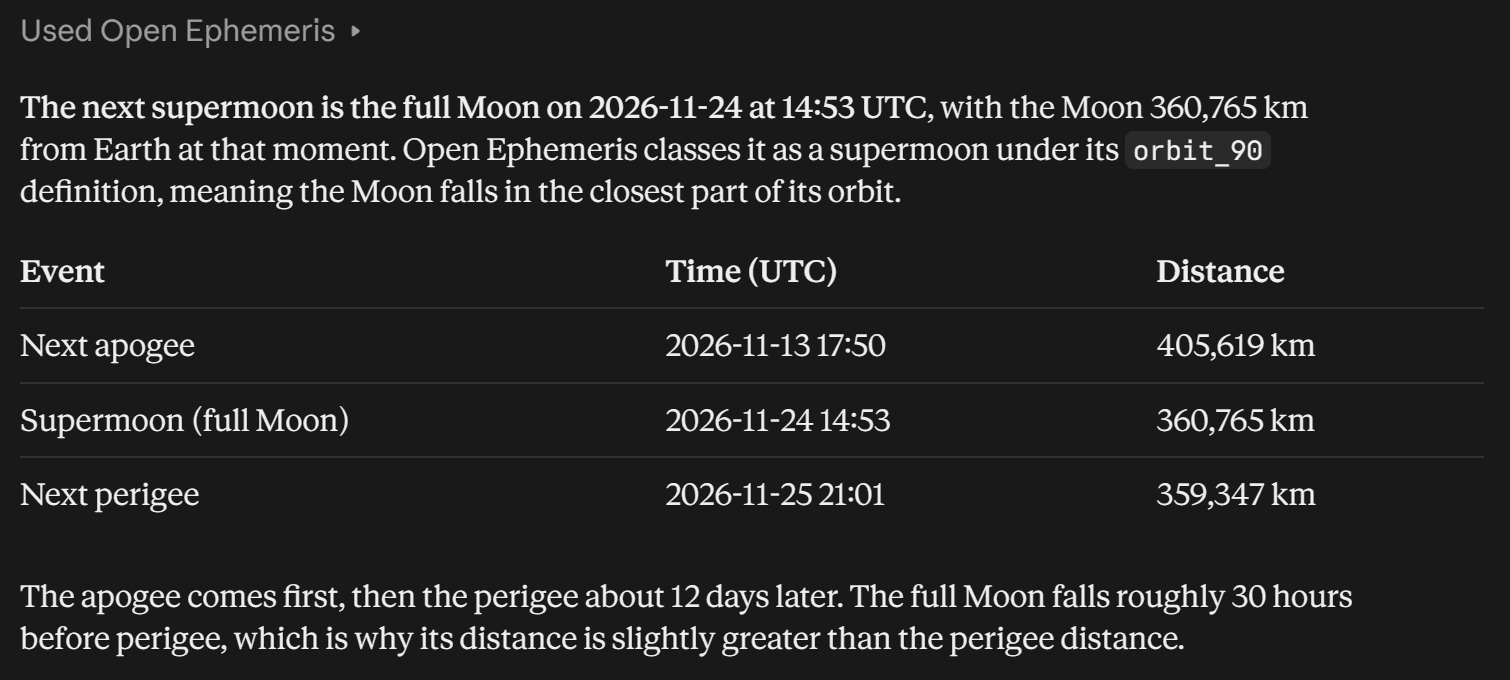
Supermoons, eclipses and close pairings of planets, with the local times, so the date goes in your calendar before it happens.

Ask“When is the next supermoon, and how close will it be?”

An assistant's answer giving the next supermoon's date, time and distance, with the apogee and perigee around it.
A real answer from Open Ephemeris.

More you will be able to ask

  • “Where will the Moon rise behind the skyline on Friday?”
  • “Will the next eclipse be visible where I live?”
  • “Can I see the Milky Way core from here this week?”

Questions

What is Open Ephemeris Sky?
A connector for ChatGPT and Claude that answers questions about the real sky: golden and blue hour, twilight, moonrise, the Milky Way, planets and eclipses, for any place and date. It is coming soon; sign up below to hear when it launches.
How accurate are the times?
Positions come from NASA JPL's DE440 ephemeris, the same data JPL Horizons uses, with refraction and the observer's position on Earth taken into account. Our hourly check against JPL Horizons holds the median gap to 0.09 arcseconds for 1950 to 2050.
How are golden hour and blue hour defined?
Golden hour is the Sun's centre between 4° below and 6° above the horizon; blue hour is between 6° and 4° below. No standards body defines either; these are the common photographers' conventions, and every answer states them.
What does "truly dark" mean?
The hours after astronomical twilight ends (the Sun more than 18° below the horizon) when the Moon is also below the horizon. That is when the Milky Way and faint stars show best.

See the accuracy checks on the proof page.